MeasureCamp Spain Madrid 2026: What the Session Board Revealed
MEASURECAMP SPAIN · MADRID 2026
What was on the Session Board?
AI, measurement and the people building what comes next
24 October 2026 · Madrid · An agenda created by the community
Session languages
Two session cards did not specify a language.
Sessions by primary theme
One editorial category per session. AI also appeared across other themes.
Bar lengths use a shared scale from 0 to 10 sessions.
The 18 AI-related sessions covered agents and tooling, analysts’ work, attribution, data quality and privacy.
Source: Session Board transcription from MeasureCamp Spain Madrid 2026. Theme categories are editorial groupings based on the session cards. Some handwritten cards were not fully readable.
THE STORIES BEHIND THE NUMBERS
MeasureCamp Spain Madrid 2026: What We Talked About This Year
MeasureCamp Spain Madrid 2026 is over, and after looking again at the Session Board, we wanted to write down what people actually chose to talk about this year.
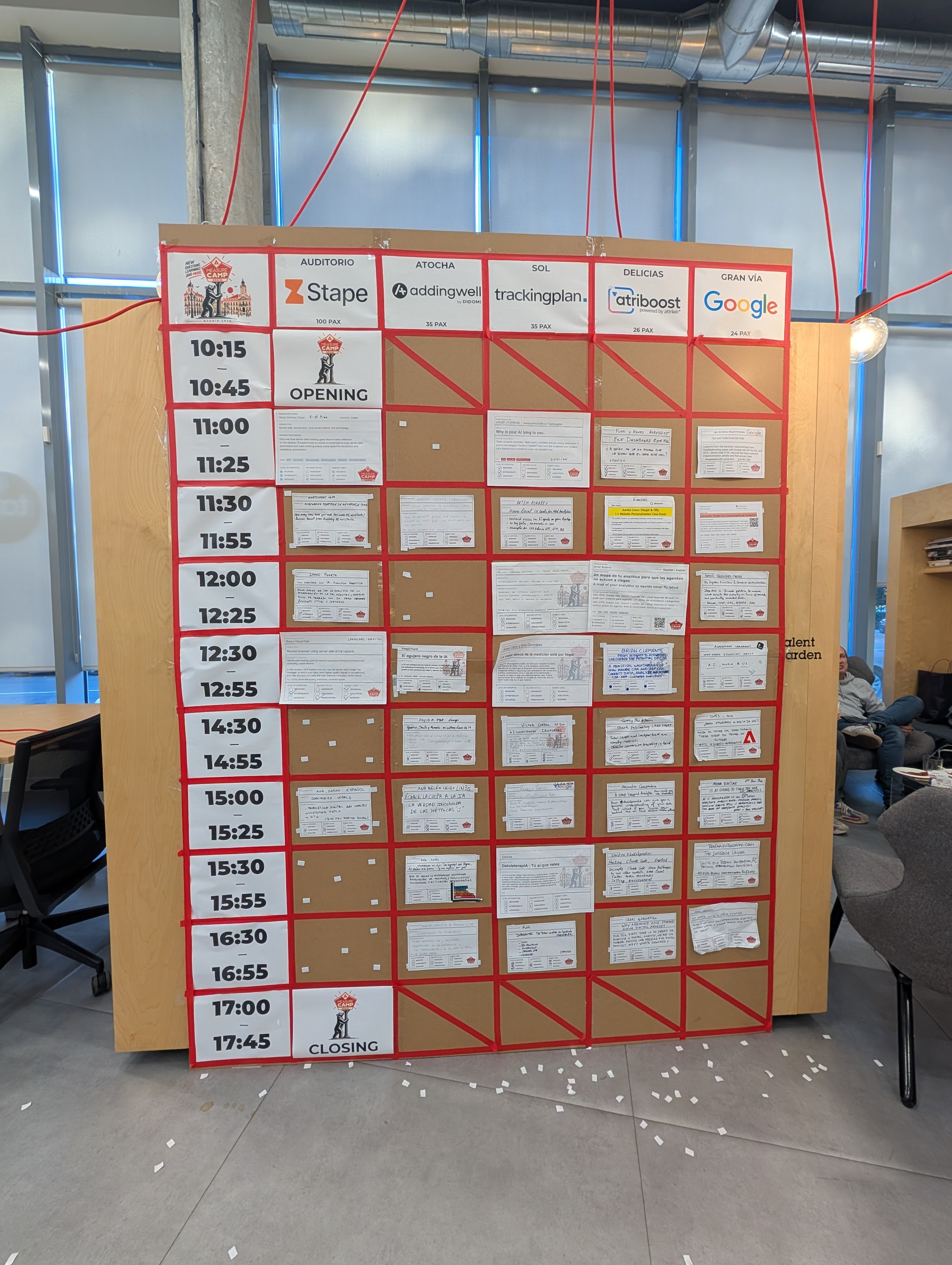
The board ended up with 35 sessions across five rooms and eight time slots. Some speakers arrived with a session already prepared. Others decided during the day that they had something they wanted to discuss and grabbed a card.
There were technical sessions, case studies, workshops and a fair number of open discussions. Of the 35 sessions, 18 were listed in English, 14 in Spanish and one in both languages. Two cards did not specify a language.
The topic that appeared most often was impossible to miss: AI.
AI dominated the Session Board. The questions were getting more practical.
18 of the 35 session cards were identified as AI-related, covering agents, large language models and their use in analytics work.
What was interesting was the type of conversation people were proposing. There were very few broad “what can AI do?” topics. Most were already about using AI in real analytics work.
David M. Pino proposed a session about the agents, skills and memory he uses in his daily work. Víctor Corral brought report automation to the board. Dmytro Khadzhyrediev proposed a technical session on using Claude Code with other models. Daniel and Rodrigo introduced the idea of organising your own AI harness.
Other cards raised questions about whether we can trust the answers these systems produce.
David Pombar presented a familiar analytics problem: sales dropped, an AI ran the correct query, and still returned the wrong explanation.
Javier Rodeiro proposed giving agents a map of the analytics ecosystem before allowing them to work with it. Piotr Gruszecki brought up the need for a semantic model if conversational analytics is expected to answer business questions properly.
Different session proposals raised a similar concern: how can AI produce reliable conclusions without consistent definitions, sufficient context and trustworthy data?
And of course, someone eventually had to ask the question everybody is thinking about.
“Is AI going to take the job of analysts?”
Session proposed by Marek Bielčiak
He was not the only one asking.
Datola proposed a group-therapy-style discussion about what analysts are still worth when AI can write code, analyse data and produce reports. Iñaki Gorostiza brought the agency perspective, asking why his company had stopped hiring digital analysts for the first time in 20 years.
Inés and Ana put another version of the problem on their card: lots of AI, but still no insight.
We certainly had plenty of questions to take home.
Server-side tracking was already past the beginner stage
Four sessions were grouped under tracking and server-side topics, with a clear focus on practical implementation rather than introductory explanations.
Oleksii Strochka from Stape proposed a session on enriching events on the server to make them more useful for attribution and optimisation. Borys Vasylchuk focused on using server-side GTM to send better signals to advertising platforms.
Igor de Martino and Miguel Fernández from Google brought implementation and troubleshooting cases around enhanced conversions, Google Tag Gateway and server-side GTM.
Laurent Werner from Addingwell proposed following one user journey from collection through to activation, including the privacy and control questions that come with it.
The session descriptions focused on data enrichment, signal quality, troubleshooting and what happens after the server-side setup is running.
Privacy, consent and attribution kept coming back
Privacy appeared in several different forms on the board.
Romain Bessuges-Meusy proposed a discussion about the Digital Omnibus and possible changes coming from Brussels around consent. Ana and Sarah brought up marketing in a cookieless environment. Another session raised privacy risks connected with AI and attribution decisions.
Attribution appeared in sessions about lead quality, offline sales, AI and marketing measurement.
Terry Packham questioned the usefulness of total leads and cost per lead, proposing estimated lead value as a better starting point.
Rodrigo Tobío described offline attribution as “the last challenge”, focusing on the connection between offline sales and digital marketing.
Pelayo Puerta described AI as creating a new black hole in attribution. Brais Calvo and Eva González asked whether the next stage of measurement could come from making better use of the data we already have.
There was also a practical Adobe case built around a sentence many teams will recognise: impressions are almost on target, but orders are nowhere near it. How do you explain why?
Analytics now reaches well beyond reporting
Adobe had three sessions on the board this year, covering personalisation, Customer Journey Analytics, Experience Platform and activation.
Alejandro Céspedes proposed looking beyond the reporting layer and exploring what working directly with Snowflake can reveal that might be difficult to see in dashboards alone.
Looking at the Session Board, it is difficult to draw a clear line around what belongs to digital analytics anymore.
One room might be discussing GA4 or attribution while another is looking at Snowflake, AI agents, CRM data or consent infrastructure.
That raises an interesting question for our profession: how much engineering, data architecture and AI knowledge will tomorrow’s digital analyst need?
Judging by the topics proposed in Madrid, quite a lot.
The board was the agenda
One detail is worth keeping because it explains MeasureCamp better than any formal programme could.
None of these 35 sessions existed as a fixed agenda when attendees walked into Talent Garden that morning.
People created them there.
Three speakers marked their cards as their first MeasureCamp session: Oleksii Strochka, Víctor Corral and Marek Bielčiak. There were probably others who simply did not mark it on the card.
Some sessions filled rooms. Some became small discussions. A few room slots stayed empty. People changed rooms, skipped sessions, continued conversations in the corridors and occasionally decided that coffee or talking to somebody they had just met was more useful than following the timetable.
That is normal at MeasureCamp.
The Session Board gives the structure, but the people in the building decide what the day becomes.
Thank you, MeasureCamp Spain community!
Thank you to everyone who put a card on that board, joined a discussion, asked a question, shared something that worked, shared something that did not work, or helped somebody else think through a problem.
Thank you as well to our volunteers, organising team, sponsors and partners who made the Madrid edition possible.
For now, we are closing MeasureCamp Spain 2026.
We look forward to seeing which questions make it onto the Session Board in 2027.
Follow MeasureCamp Spain for news about the next edition in Madrid. 💜
Stay connected with the international MeasureCamp community.
Follow us on LinkedIn Follow us on Instagram